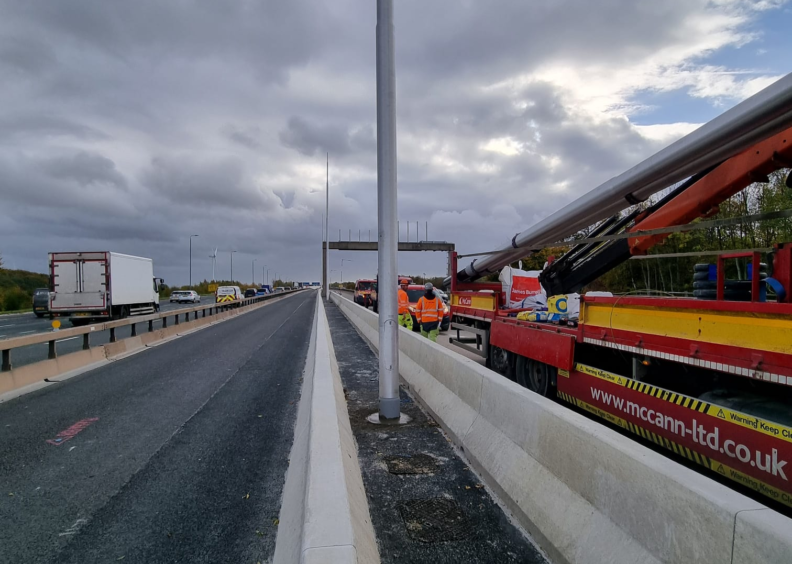
The work primarily involved renewing and permanently protecting nine critical motorway communications cabinets, together with associated ducting, chambers and cabling. The cabinets house essential systems for the safe and efficient operation of the motorway, including carriageway sensors and electronic message signs.
McCann’s Approach
McCann’s approach was designed to eliminate flood-related outages by relocating and elevating the infrastructure, while maintaining motorway operations throughout the works. Being located on an active flood plain, construction work on the cabinets took place up to 2 metres below carriageway level in waterlogged ground. This was particularly challenging during winter months, when saturated soils, standing water and mud restricted access and stability.
Working closely with National Highways, designers and supply chain partners, McCann developed a solution that lifted critical assets well above historic flood levels while preserving motorway operations. The works included new cabinets, duct runs, chambers and cabling interfaces. The renewed cabinets were repositioned up to 10 metres from their original locations and mounted on bespoke steel structures approximately 2 metres above ground level. Three custom-designed grillages were fabricated to suit site-specific conditions and provide long-term flood resilience.
The presence of uncharted, direct-buried live cables complicated excavation works. These posed a significant risk during piling and trenching activities and required careful identification to avoid accidental service disruption. To manage this risk, McCann implemented slot trenching and intrusive testing techniques to positively identify buried assets and confirm cable redundancy before any excavation works proceeded. Winter ground conditions were addressed through repeated remediation, including slurry removal and the placement of stone layers to maintain safe, stable working platforms.
Throughout the works, maintaining the uninterrupted operation of existing power and communications systems was critical to avoid disruption to the motorway. A key innovation involved attaching elevated ducting to 10 metre extendable poles with visible signage, enabling vegetation clearance without damaging infrastructure. This solution has since been adopted as best practice in National Highways’ Raising The Bar 9 Guidelines.
Results and Outcomes
Completed in July 2024, the project has delivered a resilient, long-term solution that significantly improves safety, reduces future maintenance requirements and supports National Highways’ objectives around network resilience and sustainability.
“The M62 Technology Renewal scheme between J34–J35 has been running for over a year and is nearing completion on site. During this period, it has faced several challenges during both the design and construction phases. McCann, as Principal Contractor, has demonstrated National Highways’ expected values and behaviours—Safety, Integrity, Passion, Ownership and Teamwork. This has been achieved through proactive, resilient working and a collaborative approach to resolving challenges.” Esref Ulas, Area 12 Project Manager, National Highways
Despite challenging ground conditions, programme delays and complex technical constraints, the M62 J34–35 Cabinet Renewals project delivered strong outcomes across safety, performance, sustainability and customer value.
Safety performance was exemplary with the project delivered with zero safety incidents.
Extendable hazard markers, red and white visual identifiers with warning signs attached, significantly improved visibility of above-ground assets for all operatives, and the elevation of cabinets has created safer long-term access for inspection and maintenance.
Operational efficiency was enhanced through adaptive planning. Working predominantly at night and avoiding full carriageway closures minimised disruption for road users, while completion to a revised programme demonstrated effective recovery from design delays. The relocation and elevation of all nine cabinets have eliminated flood-related service outages affecting electronic signage and carriageway sensors. Environmental benefits were also realised. By removing the need for repeated flood-repair visits, the project has reduced carbon emissions over the asset’s lifecycle, while vegetation management protocols ensured infrastructure protection was balanced with ecological considerations.
The project has improved the reliability of motorway technology systems, directly supporting safer journeys and reducing future maintenance interventions and associated costs.
The M62 J34–35 Cabinet Renewals project demonstrates McCann’s capability to deliver resilient infrastructure solutions in challenging, flood-prone environments on live motorway networks. Through innovation, rigorous safety management and collaborative problem-solving, the scheme has removed long-standing flood risks, enhanced road user safety and established new best practice for asset protection on the strategic road network. The adoption of extendable ducting markers across National Highways further reinforces McCann’s role as a leader in sustainable, forward-thinking infrastructure delivery.