Environmental
& Sustainability
At McCann, we play a vital role in shaping the modern infrastructure; however, we are conscious of the impact that our civil and electrical engineering works have on the environments that we work within. Our commitment to the environment and sustainability drives every project that we work on!


Committed to
best practices
We’re focused on reducing our impact on the environment by the careful use of natural resources, maximising recycling and minimising waste, whilst protecting and enhancing the environment in which we work and live. In the face of climate change and the energy transition, our environmental objectives focus on four key areas: audits, waste, carbon management and environmental incidents.



Sustainability for McCanns means making meaningful, measurable change and reducing our environmental impact while delivering quality and value. Over the past year, we’ve made good progress: achieving PAS 2080 certification, trialling low-carbon materials and plant, developing awareness training, and publishing our Net Zero Plan. Looking ahead, our focus is on setting science-based targets, expanding our register of low-carbon products and services, and delivering our first complete PAS 2080 project, building on our commitment to continuous improvement and climate leadership.
Eleanor Morton, Environmental Manager, McCann Ltd
Our carbon
commitment
McCann’s environmental and sustainability commitments are outlined in our Carbon Reduction Plan. The plan covers elements from alternative fuel options for our fleet and plant, trialling low-carbon plant and hand tools, reducing emissions within our supply chain (improving environmental product declarations), reducing water use by 20% and achieving zero-waste-to-landfill status.
McCann’s is committed to achieving net zero by 2040, with an interim science-based target to reduce our scope 1 & 2 emissions by 42% by 2030 and is delivered within our projects through our PAS 2080 verified process.

Accredited to PAS 2080
Our management system to reduce carbon during the design, construction and operation of England’s strategic road network is PAS 2080 verified.
The PAS 2080 ‘carbon management in infrastructure’ is a global specification for managing whole-life carbon in infrastructure. The standard recognises McCanns strategies to reduce carbon, commitment to developing more collaborative ways of working to promote innovation, deliver benefits to society and communities and make an important contribution to tackling climate change.
Reducing waste
and reusing
with purpose
The construction industry is one of the top producers of global waste. We have worked with waste broker Reconomy for our waste and resource management. In 2025, we diverted 99.9% of waste from landfill.
Outside of our partnership with Reconomy, our teams reduce waste on site by reusing excavated materials in cut and fill operations. We deliver Zero Waste Training to all our supervisors and operatives across the business and our supply chain.
With end-of-life materials that we remove from the site, rather than just send them to the landfill, we often reuse these in social value initiatives. Through Outdoor Play and Learn (OPAL) initiatives within schools it allows us to reuse cable drums and palettes to enrich children’s learning.

Switching to
smarter energy
and materials
Using solar, wind, and hydrogen energy sources over diesel, coal and nuclear fuel sources is significantly better for the environment due to the reduced emissions. Where possible, we are utilising these renewable energy sources on site and in our office facilities.
Examples include Solar-Powered Welfare Cabins and Hydrogen-Powered Tower Lights. In one area of the business, by replacing conventional diesel powered tower lights with hydrogen-fuelled units, we achieved a carbon saving of 8.86 tCO₂e. Allowing us to light working areas with emission-free energy, which leaves nothing but water vapour behind. We have used solar-powered welfare cabins on our Taylor Wimpey A5 widening project to harness the sun to support the site welfare facilities. By utilising renewable energy, we can generate an average fuel and emissions saving equivalent to over 222,000kg of CO₂e.
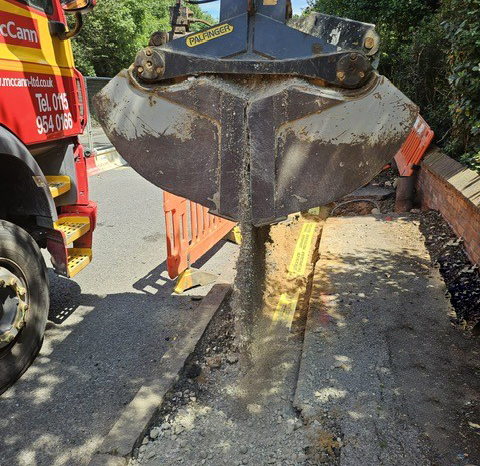
Throughout our projects, where possible, we are utilising recycled materials and other components; this reduces the need for virgin resources. One of the examples where we have implemented low-carbon alternatives is on our A52 Priory to Queen’s Medical Centre Island scheme for the client National Highways and principal contractor Morgan Sindall. McCann successfully introduced the UK’s first use of ReCO₂® hybrid aggregate on a National Highways SDF scheme, achieving savings over 6t CO₂e while maintaining programme and quality performance. Using ReCO₂® on this scheme provides a live, scalable example of low-carbon material innovation in highway construction, showcasing that sustainability targets can be met without affecting programme, quality, or cost.

Empowering our
people and
supply chain
Our team have been developing awareness training for roll out within our team and wider supply chain. These equip employees with up-to-date, relevant and critical information on how to reduce carbon emissions.